Training

PADI

Training agency

Since 1984

Illustrated coastal scene showing mountains above the water and open water below the surface.

Shop training

33 courses

Two scuba divers among kelp.
© PADI 2026

Open Water Diver

For new divers ready to earn their first scuba certification and build a foundation for future dives.

Course details

Knowledge development, confined-water practice, and open-water training work together. Online or in-person study alone does not complete the certification.

  • Understand diving principles and the equipment you will use.
  • Practice essential skills in confined water.
  • Bring those skills together on instructor-led open-water dives.

A PADI professional and a new diver signal at the surface.
© Lewis M Jefferies · PADI dealer library

Discover Scuba Diving

For someone curious about their first scuba experience, before committing to a certification course.

Course details

A supervised introduction in a pool or sheltered water. Discover Scuba Diving is not a scuba certification.

  • Get acquainted with scuba equipment.
  • Experience breathing underwater with a dive professional.
  • Find out whether you want to continue toward certification.
Learning optionBook with the shop
A freediver swims above coastal kelp.
© PADI 2015

Freediver

For swimmers interested in breath-hold diving rather than breathing from scuba equipment.

Course details

Freediver training combines learning with supervised practice. It is a separate discipline from scuba, not a substitute for scuba certification.

  • Learn the principles behind freediving.
  • Develop water skills with professional supervision.
  • Understand the importance of buddy procedures and responsible practice.
Learning optionBook with the shop
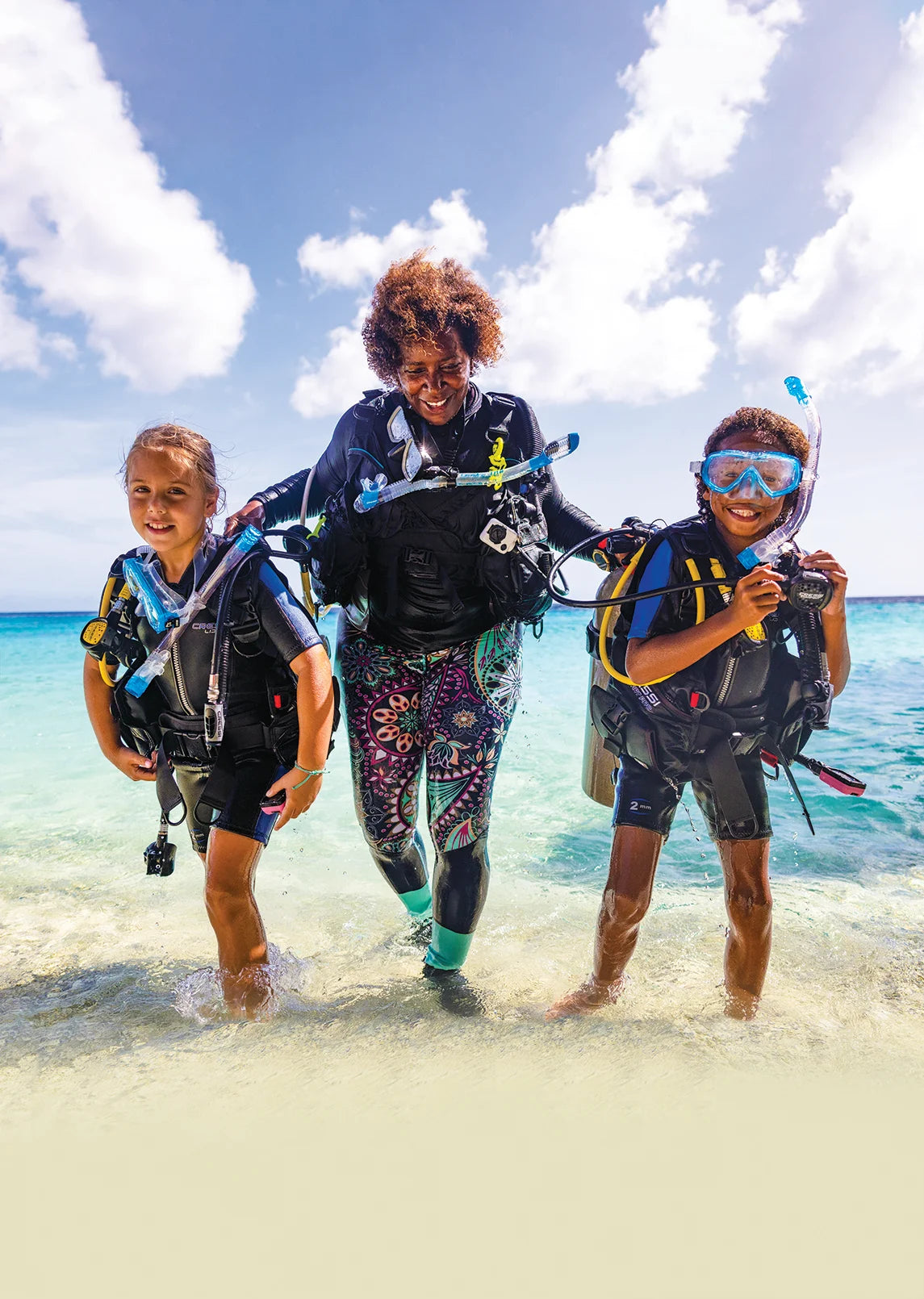
Children prepare to enter the water with a PADI professional.
© PADI 2026

Bubblemaker

For children curious about scuba and families looking for a supervised first introduction.

Course details

An introductory youth experience, not the Open Water Diver certification. Discuss water comfort, age eligibility, and parent or guardian consent with the shop.

  • Become familiar with child-appropriate scuba equipment.
  • Try breathing underwater in shallow water.
  • Explore with direct professional supervision.
Learning optionBook with the shop
A young diver practices scuba skills in a pool.
© PADI 2026

PADI Seal Team

For young explorers interested in learning scuba skills through pool-based activities.

Course details

A youth pool program with activity-based learning. Ask about the current missions, participation requirements, and progression for your child.

  • Practice skills through AquaMissions.
  • Explore themes such as navigation, buoyancy, and underwater photography.
  • Build familiarity with scuba in a supervised pool setting.
Learning optionBook with the shop
A diver practices underwater navigation.
© PADI 2026

Advanced Open Water Diver

For certified divers who want to broaden their experience and discover new interests.

Course details

Five Adventure Dives: Deep and Underwater Navigation, plus three chosen topics. An Adventure Dive introduces a specialty; it is not automatically the full specialty certification. Online or in-person study alone does not complete the certification.

  • Develop underwater navigation skills.
  • Explore deeper recreational diving with an instructor.
  • Sample three other Adventure Dive topics.

A diver practices assisting another diver at the water’s edge.
© PADI 2026

Rescue Diver

For divers ready to expand their awareness from their own dive to the people around them.

Course details

Knowledge development and practical training build a more attentive diver. Discuss your current diving qualifications and first-aid/CPR training before choosing a start date. Online or in-person study alone does not complete the certification.

  • Recognize problems before they develop further.
  • Build confidence in responding to diver difficulties.
  • Apply your learning through practical rescue scenarios.

Divers make a supervised entry from a dive boat.
© PADI 2026

ReActivate

For previously certified divers returning after time away or wanting a focused skills refresh.

Course details

The knowledge review and in-water refresher serve different purposes. Completing both is the route to a ReActivated certification card; this is not a new entry-level certification. Online or in-person knowledge review alone does not complete ReActivate; the in-water skills refresher is also required for a ReActivated card.

  • Revisit the diving knowledge that needs a refresher.
  • Review equipment and familiar skills with a professional.
  • Rebuild comfort before your next diving plans.

PADI Emergency First Response course graphic showing a diver assisting another diver at the surface.
PADI Emergency First Response course artwork

Emergency First Response

For divers and nondivers who want practical first-aid and CPR education.

Course details

Primary and Secondary Care combines learning with hands-on practice. It is distinct from a CPR-only course; discuss the appropriate combination for your diving pathway. Online or in-person study alone does not complete the course; instructor-led skills practice must also be completed.

  • Learn primary-care response, including CPR.
  • Explore secondary care for injuries and illnesses.
  • Practice assessment, bandaging, and related first-aid skills.

An emergency-oxygen training scenario beside a boat ladder.
© PADI 2026

Emergency Oxygen Provider

For divers, boat crew, and others who want to understand emergency oxygen in a diving-response setting.

Course details

Knowledge and practical equipment training, without a required water session. You do not have to be a scuba diver to take this course. Online or in-person study alone does not complete the course; the practical skills must also be completed.

  • Recognize diving injuries where emergency oxygen may be needed.
  • Become familiar with emergency-oxygen equipment.
  • Practice the response skills taught by the instructor.

Drysuit divers in green open water.
© PADI 2026

Drysuit Diver

For certified divers interested in drysuits and the equipment skills that go with them.

Course details

Equipment learning and confined-water practice lead into open-water training. Bring questions about the suit you own or are considering. Online or in-person study alone does not complete the certification.

  • Compare drysuit fit, styles, and undergarments.
  • Develop buoyancy and suit-air management skills.
  • Learn about drysuit care and maintenance.

Cold-water divers carry enriched-air cylinders toward a lake.
© PADI 2016

Enriched Air Nitrox

For scuba divers who want to understand and use enriched-air nitrox within its limits.

Course details

Independent study is followed by practical application. Nitrox is not a permission to dive deeper; the training explains its different planning limits. Online or in-person study alone does not complete certification; the required practical applications must also be completed. Training dives are optional.

  • Understand what changes when your breathing gas contains more oxygen.
  • Practice analyzing and recording a cylinder’s oxygen content.
  • Learn to set a dive computer for the analyzed gas.

A scuba diver wearing a yellow full-face mask.
© PADI 2026

Full Face Mask

For certified divers exploring a mask system that covers both the eyes and nose and incorporates the breathing interface.

Course details

Specialty training for a different equipment configuration. The exact mask and any communication equipment should be discussed before the course.

  • Get familiar with a full-face-mask system.
  • Explore its equipment-specific operation.
  • Discuss applications such as underwater communication.

A dive light illuminates a school of fish in PADI Night Diver imagery.
© PADI 2026

Night Diver

For certified divers curious about how familiar water changes after daylight fades.

Course details

A specialty combining knowledge development with instructor-led night diving. Site and timing depend on the training arrangements and conditions. Online or in-person study alone does not complete the certification.

  • Develop familiarity with dive lights.
  • Explore the different character of a night dive.
  • Observe marine life that becomes active after dark.

Divers practice neutral buoyancy above a reef.
© PADI 2026

Peak Performance Buoyancy

For certified divers who want more deliberate movement and better control in the water.

Course details

A focused practical specialty. Your current equipment and the skills you want to improve make useful starting points for the instructor. Online or in-person study alone does not complete the certification.

  • Refine neutral buoyancy.
  • Practice hovering with control.
  • Move around aquatic life with less disturbance.

Scuba divers explore the steps of a submerged wreck.
© PADI 2026

Wreck Diver

For divers interested in wrecks as places to explore, observe, and understand.

Course details

A recreational specialty with a defined training scope. Discuss the particular wreck interests you have; this is not unrestricted overhead-environment training. Online or in-person study alone does not complete the certification.

  • Develop an informed approach to wreck exploration.
  • Consider the setting and features of a wreck.
  • Respect the site’s cultural and environmental significance.

Divers with a light beside a submerged pinnacle in PADI Deep Diver imagery.
© PADI 2026

Deep Diver

For qualified divers interested in extending their recreational deep-diving education.

Course details

Knowledge development and instructor-led deeper dives. This recreational specialty is distinct from the technical paths in TecRec. Online or in-person study alone does not complete the certification.

  • Consider planning and gas management for deeper dives.
  • Build awareness of narcosis and deeper-water challenges.
  • Refine buoyancy and contact with your buddy.

Divers using underwater scooters in PADI Diver Propulsion Vehicle training imagery.
© PADI 2026

Diver Propulsion Vehicle

For certified divers interested in learning to dive with an underwater scooter.

Course details

A PADI equipment specialty. Buying a Genesis scooter or asking about a guided experience is separate from completing this training. Online or in-person study alone does not complete the certification.

  • Get acquainted with a diver propulsion vehicle.
  • Explore how propulsion changes the diving experience.
  • Build familiarity with DPV diving under instruction.

Divers step from a dive boat into the water.
© PADI 2026

Boat Diver

For certified divers who want to feel more at home diving from boats.

Course details

PADI’s specialty includes two boat dives. Ask which boat and current training arrangement the shop is using. Online or in-person study alone does not complete the certification.

  • Learn boat-diving terminology and etiquette.
  • Become familiar with the use of lines and boat procedures.
  • Practice skills relevant to entries, exits, and surface signaling.

A diver with an underwater camera photographs marine life.
© Jay Clue · PADI dealer library

Digital Underwater Photographer

For divers interested in making more intentional pictures beneath the surface.

Course details

Photography learning connected to practical underwater experience. Bring the camera system you use, or ask what to consider before choosing one. Online or in-person study alone does not complete the certification.

  • Explore underwater lighting and strobes.
  • Understand color in underwater photographs.
  • Learn techniques for reducing backscatter.

Divers move through the water with a surface-marker buoy in PADI Drift Diver imagery.
© PADI 2008

Drift Diver

For certified divers who want to understand diving in moving water.

Course details

Specialty learning and supervised diving in suitable conditions. The environment and your previous experience help determine the next step. Online or in-person study alone does not complete the certification.

  • Learn about currents and drift-diving planning.
  • Develop skills for entries and descents in this environment.
  • Explore buoyancy control and surface signaling.

A diver uses a compass underwater in PADI Underwater Navigator imagery.
© PADI 2016

Underwater Navigator

For divers who want a more deliberate sense of direction underwater.

Course details

A focused specialty that develops navigation beyond simply following another diver. It pairs naturally with interests such as night or wreck diving. Online or in-person study alone does not complete the certification.

  • Develop observation skills for navigation.
  • Practice using an underwater compass.
  • Build confidence following an intended route.

An ice diver beneath the opening in a frozen surface.
© PADI 2026

Ice Diver

For experienced, appropriately qualified divers interested in a specialized overhead environment.

Course details

A specialized team-based course, not a normal recreational excursion. Discuss the entry requirements and actual training location directly with the shop.

  • Understand the team approach to ice diving.
  • Explore the roles of diver, tender, and surface support.
  • Learn how safety-diver responsibilities fit the operation.
Learning optionBook with the shop
A public-safety dive team works at the shoreline.
© PADI 2026

Public Safety Diver

For divers interested in the coordinated roles and responsibilities of public-safety diving.

Course details

Scenario-based team training. Discuss your intended role and organization’s requirements; a course does not itself confer employment or operational authority.

  • Work through primary-diver and safety-diver scenarios.
  • Explore supervisor responsibilities.
  • Understand the contribution of surface support.
Learning optionBook with the shop
A rebreather diver signals underwater.
© PADI 2026

Rebreather

For qualified scuba divers exploring recreational rebreather training and a specific unit.

Course details

PADI Rebreather Diver is a recreational program. Identify the unit and intended diving with Gary first; technical CCR goals may call for a different pathway.

  • Learn about a different breathing system.
  • Understand why training is tied to the equipment used.
  • Distinguish a recreational rebreather path from technical CCR training.

A sidemount diver moves through open water.
© PADI 2013

Sidemount Diver

For certified divers considering carrying cylinders alongside the body instead of on the back.

Course details

An equipment-configuration specialty. Sidemount does not by itself qualify a diver for caves, decompression, or other technical environments. Online or in-person study alone does not complete the certification.

  • Explore configuration, weighting, and trim.
  • Learn gas-management considerations for two cylinders.
  • Practice equipment handling and problem management.

Technical divers descend beside a submerged structure.
© PADI 2013

TecRec

For experienced divers considering a deliberate progression into technical diving.

Course details

TecRec is a family of programs, not one course with a single depth limit. Gary will need to confirm the exact levels, units, and local training arrangements.

  • Explore the different open-circuit and rebreather pathways.
  • Consider equipment, planning, and team preparation.
  • Match the training stage to your experience and goals.
Learning optionBook with the shop
Divers document observations above a reef in PADI AWARE Specialist imagery.
© PADI 2026

PADI AWARE Specialist

For divers and nondivers who want a practical introduction to ocean conservation.

Course details

Learning and an instructor-led workshop connect ocean awareness to everyday action. Scuba certification is not required for this education path. Online or in-person study alone does not complete the course; the instructor-led workshop is also required. No training dive is required.

  • Explore pressures facing marine environments.
  • Consider responsible wildlife encounters and imagery.
  • Create an action plan for contributing locally.

A diver collects discarded bottles in Dive Against Debris program imagery.
© PADI 2026

Dive Against Debris

For divers interested in turning concern about marine debris into informed survey work.

Course details

Knowledge development and an instructor-led survey dive. The program includes learning what should be removed and what should be left in place. Online or in-person study alone does not complete the certification.

  • Understand the effects of debris in the ocean.
  • Learn to assess debris during an underwater survey.
  • Record findings that contribute to citizen-science data.

Divers observe a shark in AWARE Shark Conservation imagery.
© PADI 2026

AWARE Shark Conservation

For people interested in understanding sharks and contributing to their conservation.

Course details

Conservation education rather than a promise of a shark encounter. Ask which current program format the shop teaches. Online or in-person study alone does not complete the course; complete the remaining program requirements with the shop.

  • Explore the role of sharks in marine ecosystems.
  • Understand threats and conservation priorities.
  • Discover ways observation and advocacy can contribute.

A divemaster leads divers through cold open water.
© PADI 2026

Divemaster

For qualified, experienced divers exploring their first professional leadership path.

Course details

Professional development, not the recreational Master Scuba Diver recognition. Discuss your existing certifications and experience before planning the training. Online or in-person study alone does not complete the professional qualification; the required practical training and assessments must also be completed.

  • Develop skills for leading underwater tours.
  • Learn about assisting with scuba classes.
  • Build leadership that encourages care for the ocean.

An instructor demonstrates an underwater skill with another diver.
© PADI 2026

Instructor

For dive professionals considering a teaching role or a next step in instructor development.

Course details

This is the broader instructor-development conversation, not a second name for a separately defined course. The specific pathway depends on your background.

  • Review your existing professional qualification.
  • Explore Assistant Instructor and Open Water Scuba Instructor pathways.
  • Identify the development and examination steps that apply.
Learning optionBook with the shop
An instructor demonstrates buoyancy with a diver in Open Water Scuba Instructor imagery.
© PADI 2026

Open Water Scuba Instructor

For eligible dive professionals pursuing the PADI scuba-instructor qualification.

Course details

Completing instructor development and passing the examination are distinct steps. Confirm the actual program delivery and prerequisites with the shop.

  • Understand how the Assistant Instructor and OWSI parts form an IDC.
  • Prepare for the teaching responsibilities of an instructor.
  • Plan for the separate Instructor Examination.
Learning optionBook with the shop